Hello!

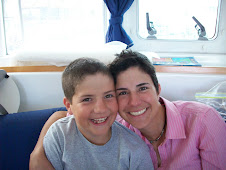
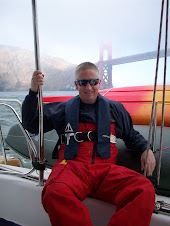
Welcome to our mid-life crisis! These are the chronicles of Laura and Patrick, their young son Jack, and their goofball Labrador Retriever named Evinrude (Rudy), as they travelled the Sea of Cortez and the Pacific coast of mainland Mexico in their catamaran. We went cruising in search of a change of pace, a closer knit family, and peace of mind. We found all three and more. The fun all started in October, 2008 and nearly four years later the Mexican adventure came to an end August 3rd, 2012. With our mid-life crisis cured in Mexico, we are excited to start a new adventure - life back in America.

Candeleros Chico

Candeleros Chico
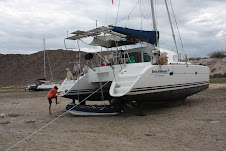
Just another beautiful day at anchor on the Baja. 2010

Dolphins at play in the bow wake 2011

Dolphins at play in the bow wake  2011

Friday, January 27, 2012

Something Wrong in Barra

A confluence of dead fish caught in an eddy and some of the birds circling overhead for the ones just dying.

Two years ago when we first visited Barra de Navidad, there were many, many fishermen plying the waters of the Lagoon. Some had nets, others were diving for clams and oysters. Just entering the long, dredged canal that leads to the lagoon, you were forced to drive around fishermen, some in the traditional boats that looked like dugout canoes, and others in their modern pangas. Not so, this year.
Every day now, thousands of fish float dead on the surface. They are mostly a six to eight inch, herring-type fish, but there are other varieties too. The winds push them around the lagoon and the tide sucks them out into the bay. They look freshly dead, all of them have bright red marks by their gills, most haven't even begun to swell with gases. Every day, at various time of the day, the water is disturbed by scores of fish swimming erratically in their death throws. Hundreds of pelicans, seagulls, frigates and terns swarm in the skies feasting on the easily caught dying fish. As you can imagine, there are few fishermen to be found in the water.
We've heard that this is an outcome of the Jova hurricane that pummelled the Barra area this last hurricane season. We were told that the lagoon became contaminated by sewage and has not recovered. Whatever, the reason, the sight is disturbing and our hearts go out to the fishermen that once worked this water.

***********
Below is a picture of our favorite restaurant in all of Mexico, found in Melaque. It just tastes like home. They have all the items you find in a Mexican restaurant in America like chimichangas and fajitas, which you never find in an authentic Mexican restaurant in Mexico. We found out that extended family members own restaurants in America that have the exact same menu.

Tuesday, January 24, 2012

Life in Barra

A Barra de Navidad Water Taxi in Service


The Grand Bay Hotel is an enormous, luxurious resort overlooking the Barra Lagoon, with views out to the ocean.


Some of the water taxis lined up at their docks, awaiting customers. Several different taxi companies ply the lagoon, taking customers between Collimilla and Barra, the two towns on the huge Barra Lagoon


One of the many lagoon-side restaurants that line the shore.


Barra is a popular tourist town for Mexicans and foreigners alike, with lots of shops, restaurants, hotels and charming streets to meander.


Every day, Jack writes a short essay about some topic or other. Here's his view of Barra de Navidad.


"Barra de Navidad is the closest thing to assisted-living on a
boat. If you wanted to, you would never have to leave your boat.
People in pangas will bring everything out to you, for a price. You can
get ice, drinks, food, trash pick-up, drinking water, bakery goods,
propane, fuel, and laundry services delivered right to your
boat. There is even a water taxi service so you don't have to launch
your dinghy. If you want to be lazy, this is the place to be."

It's a true accounting, and I have to say, it's very nice. Yesterday, we had our empty propane tank hauled away, our dirty laundry picked up, and a fresh delivery of baguettes from the French Baker, all before 9:30 AM (we've never gotten so much accomplished so early in the morning!). Then later, Jack and I went in and had a great day playing at the Sands Hotel pool with friends and Patrick and Rudy took a water taxi into the beach for a romp in the ocean surf.


Barra is the only place I've been where the locals are all set to provide boat-side services to the cruisers. Most towns do not offer these conveniences. Since Barra and Collimilla already had an extensive water taxi service system in place for their own needs, it's easy to see how these entrepenuers branched out to make even more money off the cruisers. Adding to the amenities, is the fact that the anchorage is free and flat calm, so it's easy see why so many cruisers enjoy a long stay in Barra.

Saturday, January 21, 2012

The Mexican Riviera


The lagoon waterfront in Barra de Navidad


I love this butcher shop's logo.


At the beach in Cuastecomate, JaM is anchored in the background.

Below, A street in Cuastecomate


Coming straight from La Paz where it's cold (50's at sunrise), windy and semi-desert, and moving 400+ miles south to Chamela sure highlights the difference between the Baja and the mainland. Here on the mainland, it's warm (80+ at sunrise), with very gentle breezes, and lush jungle. It's simply wonderful. The other big difference is the proliferation of people, resorts, hotels, and restaurants that line all the anchorages on the mainland.

Sunday, January 15, 2012

Passage Lessons


We had our second full night's sleep last night, and now we are recovered from our passage between La Paz and Chamela. The passage was just shy of four full days/nights and took us 92 hours, and covered about 450 nm miles.. We only used the engines on the last 40 miles when the wind was on our nose. This was the longest passage we have completed since arriving in Mexico and we learned some good lessons, had some scary moments, and lots of good sailing.

We left on a Norther, hoping for a good push to get us going. Unfortunately, the weather was a little stronger than the weatherman anticipated and the 6-8 foot swells at the top of the Cerralvo channel promised to be very nasty at the bottom of the channel where they funnel into a bottleneck, so we were obliged to sail around Cerralvo Island to avoid the channel. While that kept us out of a nasty situation, it meant a 20 mile detour to the East with the wind/seas on our beam, before we could turn the boat to the south and have the wind/seas on our stern. As I've mentioned before, it is no fun to have short period waves hitting a catamaran on the beam, especially when they are six foot high, short period waves in 20-25 knots of wind. It took seven hours from leaving our anchorage before we could start heading south on the outside of Cerralvo Island - it was a very long, unfortunate, uncomfortable start to our journey. Lesson learned on that was, "If you are leaving on a wind storm, position yourself in an anchorage where all you have to do is sail out of it and be immediately on your way."

Things got better quickly once we turned south, which was good since both Jack and I were getting very sick. The seas were pretty worked up, but mostly in one direction and as we moved further south and away from land, the waves became further spaced apart, which helped immensely. We were sailing wing on wing, using our spinnaker pole to hold the jib out to the side and were making about 8 - 9 knots. The rest of that day went well and we flew along.

Then, disaster. It was my watch and I was taking the time to clean the cabin windows before night set in. Since I was working, I wasn't paying as much attention and failed to see the small floating cube of styrofoam that bouyed a long-line, before it was too late. We didn't have time to turn and were hooked by a shark fisherman's long-line gear with its heavy poly-propalene line, thick steel leaders, and huge hooks. Being very concerned for our sail drives with the heavy line pulling on them and our boat sailing so fast, I immediately turned up in to the wind to stop our boat. Unfortunately, the wind was about 20 knots and the spinnaker pole was still attached to the jib. When we turned up into the wind, the jib was back-winded against the bamboo spinnaker pole and SNAP went the pole. It exploded spectacularly into pieces. If there was a choice to make between saving the pole or the sail drive, the sail drive would always win, but we were heartsick anyway. We love that spinnaker pole and used it often for wing on wing sailing - our favorite, most comfortable, and fastest way to sail. Lesson learned - "The person on-watch, needs to BE ON-WATCH, not distracted by other things." I thought I knew that, but I guess I didn't.

Since we were under sail, the engines were not going, but the lines were wrapped up around the sail drive and we couldn't get it loose. Night was falling and the seas and winds were still high, so it wasn't safe for Patrick to go swimming right then. We simply cut ourselves free from the styrofoam and tied the dangling lines up to our stanchion, to deal with later. We turned back on course and cleaned up the pieces of the spinnaker pole. We couldn't hold a wing on wing course anymore without the pole, so our speed dropped down to 5 and 6 knots. Bummer.

The next day, the wind was lessening to 15 knots, and the seas were down to 4-5 feet, but Patrick still wasn't feeling comfortable about jumping in to untangle the sail drive - until he noticed a funny whine that was coming from that area of the boat. We turned up-wind again, dropped the main, backwinded a small section of the jib, turned the rudders toward the wind, and hove-to. Heaving-to makes the wind push you one way, and the rudder, the other. This effectively holds your boat slightly nose into the waves, but moving only at .5 to 1 knot. Patrick suited up, tied a big rope around his waist and jumped in. He quickly unwrapped the pieces of poly-propalene and ascertained that both sail drives appeared undamaged. Once back on board, we started up the engines to test them and found them undamaged. We quickly got the sails back up, turned off the engines, and started on our way again.

The wind kept lessening over the rest of that day and night until finally we were able to use our spinnaker on Day 3. It was a joy to travel along on the flattening seas, pulling along at a good clip in the gentle breeze. For safety, we pulled the spinnaker in at night and continued on with the regular sails. Our power drain at night was remarkable due to the demands of the auto-pilot, GPS, and the navigation lights, along with the regular drains of fridge, lights, etc. Adding to the fact that the skies were overcast, so our solar power was not very effective. At night, with the auto and nav lights on, we were draining over 30 amps per hour. This was the first time we had seen the effects of a long sailing, passage. Lesson learned, "If we were going on a big passage like a puddle jump, we would need a wind generator or our power usage would have to seriously change." Another thing we learned was that our helm seat is akin to a torture device over a longer passage. Good thing we have no plans to do a puddle-jump.

Day 4 was very similar to the previous day. The wind kept lessening a bit, down to about 8 knots. We threw up the spinnaker again. Unfortunately, I did not get the spinnaker sock finished before we left and so we still needed to use the main as a wind blanket. However, the main had been flogging around horribly in the swell and light wind. The wind was forecasted to continue lessening, so we decided to leave the main down. Well, guess what happened? The wind picked up right before sunset, right before we were going to drop the spinnaker anyway. We all talked our parts through and went up to pull it down, with the winds at about 15 knots. Patrick threw off the one bottom line on the spinnaker and all hell broke loose. 46 feet by 25 feet of fabric started whipping about in the wind. It was exciting. Working all together, we had trouble getting that wild thing safely on the nets. But we did, no injuries outside of a friction burn on my hand, and a few pulled back muscles. Lesson learned - "Don't screw around with spinnakers - either use a sock or use the main - but you have to have some way to control it."

That craziness happened at sunset and we were still 70 miles out of Barra de Navidad, our destination. I was feeling battered, bruised, and tired from lack of sleep. So when the wind switched around from a light NW (oh, did I mention that right after we dropped the spinnaker the wind died right off?) to a light breeze from the SE, I was done. Suddenly we were nose into the wind, on a long stretch of highly trafficked water, at night. It was going to be a long night Patrick took pity on me and suggested we pull into Chamela which was just 30 more miles on. Going into an anchorage at night is asking for trouble, but I jumped at the suggestion. We had a few things in our favor. We had been there before, we had the waypoints from our earlier trip, Chamela is a large bay with a mile wide entrance, no rock obstacles and a sand bottom, there was a full moon, and we had an excellent guide book with more waypoints. Using our GPS and radar as guides we pulled safely into the anchorage and dropped our hook exactly 92 hours from our start time.

Saturday, January 7, 2012

One month gone, and what do we have to show for it?

God bless my old Pfaff sewing machine. I use it so much more than I ever thought I would


Well, actually, quite a bit! It's been almost an exact month since we pulled into the La Paz Harbor, and boy did we get a lot done.
First, we'll set aside all of the socializing we have accomplished with our good friends here in La Paz, and go straight to the work we've gotten done.

Patrick saved a man's home and dog from certain peril. Then he polished our fuel (a long, drawn out process), cleaned out the gunk in the fuel tanks, and replaced the deisel and oil filters in the engines. Then he had the water pump rebuilt for the refrigerator (both the spare and the one being used) and replaced it to get the refrigerator operational again. Also Patrick and Jack have been working on checking over our inventory of spare parts and replacing items that are needed since La Paz has so many boating stores here. Patrick and Jack have re-provisioned the fuel and food so that we are ready for any diversion our next jump hands us.

Meanwhile I have been working on all the little projects that fill up a boatwife's day - cleaning, cooking, storing provisions, polishing, scrubbing, washing dishes, laundry, changing sheets, cleaning heads, and homeschooling. My special project has been tackling the construction of a spinnaker sock. One week ago, I had no thought in my head of undertaking a project like that. Then in the space of one day, the idea had taken hold and since then, hours and hours of my time have been consumed by it.

It all started when someone mentioned they had a ripped spinnaker and they were going to use the ruined sail to make a spinnaker sock for their other spinnaker. I had never thought of making a spinnaker sock, I just knew they were downright expensive to buy ($20 per foot!). Well, he said he had enough matrial for me to make one and that another boat had the instructions. And that was that, my project began.

Let me all assure you that sometimes you can be too cheap for your own good. If I had simply purchased the ripstop nylon instead of cutting apart an existing spinnaker, I would have been finished days ago. Unfortunately,a sail has an inherent curve in it and when you cut it apart, it still has a curve in it - kind of like when you peel an apple in one long slice. The peel curls like a corkscrew, just like my fabric does. I've been fighting it for days now, and I think I finally have it licked, but the sock isn't done yet so I will have to let you know the outcome. It will be really great to have a spinaker sock since our next passage looks like it will have lots of light wind. We hope to be leaving La Paz this afternoon to go stage up in the islands outside of La Paz. Then on Sunday, we will start our passage to Barra de Navidad, about 400 or more miles away.

Tuesday, December 27, 2011

A Very Good Christmas

All pictures are courtesy of Nancy on Eyoni, our favorite photographer

At the beach with my hero

Ethan from Eyoni exhibiting a perfect Bocce Ball tossing form, while Rich from 3rd Day watches


Lori from 3rd Day and me, sharing a shot of Christmas Cheer


Running with Rudy across the sand flats


Picnic at the wreck. Somebody's dream died here years ago when they dragged, but the remains make a convenient meeting spot and picnic table.


********


It's hard to get the Christmas spirit when you live on a boat in the sub-tropics. All of the cues I used to have that would put me in the Christmas mood are gone. There's no school Christmas pageant, no school Christmas break, no weeks of shopping for the perfect present for loads of people, no watching endless commercial reminders on the TV in case you had missed the fact it was Christmas, no going to the tree farm to chop down a Christmas tree, no frantic preparations for hosting a dinner for 30 of your closest relatives and friends (okay that one I don't really miss). Anyway, you get the point.


However, you can't beat waking up on your boat, opening a couple nice little presents found under your 1 foot high plastic tree, and then meeting up with good friends on a nearby beach for a picnic and a Bocce Ball game, with kids running around on the sand flats, and Rudy racing around everyone, fishing, playing fetch, and trying to steal the Bocce balls.


After the picnic, we headed over to 3rd Day for a potluck dinner and movie.


It was a perfect day.

Monday, December 26, 2011

No Good Deed Goes Unpunished


We’ve hung around La Paz longer than anticipated, first because there was no wind and then because there was too much wind. Unfortunately, any time you get high winds and lots of boats together, there is usually drama. This time around, Just a Minute’s captain took a starring role.
Our story starts a few days ago when a Norther blew into town. As Norther’s go, it was a pretty good one with a Gale Warning posted for the entire Sea of Cortez, and winds forecasted in the 30’s to 40’s.. Here in the La Paz harbor, we have some wave protection from a low lying spit of land, but no wind abatement. The first day, Thursday, we saw winds in the teens. Around 2 a.m. Friday morning, the wind started mounting and as dawn broke, the winds kept growing.
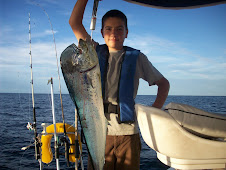
As I came up the stairs at dawn on Friday, I noticed a new boat anchored close to us with a dog running around on deck. As my sleep-numbed brain started to function I realized that the boat wasn’t anchored, it was dragging - right over the sand bar and moving past us. I knew we weren’t in danger, but there were several other boats in the downwind direction that it was moving toward. I put a hale out on the radio, to the fleet, warning of the danger. Then I woke up Patrick. I was very worried about this boat since the dog on its deck was obviously scared and there was no sign of the crew.
The seas were up about two feet and the winds were blowing about 20-25 knots so lowering the dinghy was a chore, but Patrick was soon on his way. He went to a nearby boat and asked that captain to jump in and help him. Christian, his fellow volunteer, was an excellent person to have along. He already had a spare anchor and rode lined up ready to use on the dragging boat. Together, they headed off to the dragger, a large ketch named Callisto.
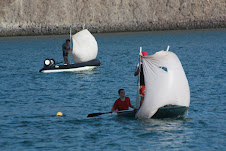
Callisto was an obvious live-aboard with sun tarps up, lots of junk on deck, and the dog running around. At first Patrick and Christian just tried banging on the boat, trying to wake up the crew they assumed was on board. No one answered and the dog seemed friendly, so they tied up alongside and climbed on board. The boat was moving quickly now that it had passed over the sandbar. They found out that the dog was the only one on board. The boat had broken loose from its mooring ball, and so its anchor was on deck and ready to deploy. Christian threw the anchor over and started paying out chain.
Like most permanent live-aboard boats, this one had lots of junk scattered on deck. Patrick came up to the bow to help and when a wooden pole fell over and landed on the anchor chain, Patrick bent over to pick it up. As he leaned forward, Patrick put his head right into the spinning blades of a wind generator that was screaming along in the wind. The boat-owner had mounted the blades right over the anchor windlass at about 5 feet. It was sideways to Patrick and with the speed of the blades, he never even saw it.
All Patrick could do was sit down and try to cover the wound that was instantly pouring out blood. You know how head wounds are - it looked like a scene from a slasher movie. Of course it was an old wind generator with metal blades, so thankfully Patrick was not scarred for life, and did not lose an eye. It’s a miracle that he only has one, deep, 1” long gash, right at his hair line.
The anchor quickly grabbed and the boat (and dog) was saved just a few hundred yards from shore. With that rescue complete, it was time to rescue the rescuer. Thankfully we have lots of good friends in La Paz. Rich on 3rd Day reached Callisto just after Patrick hit his head. Once Callisto was secured, Rich took Patrick over to Hotel California. Rick on Hotel has a car and he drove Patrick off to the hospital for stitches and wound cleaning. And so another day comes to end with another good lesson learned - not every boat owner has a boat that’s safe to board. Who would put spinning metal blades 5 feet above an area that you have to access?????